|
SITE
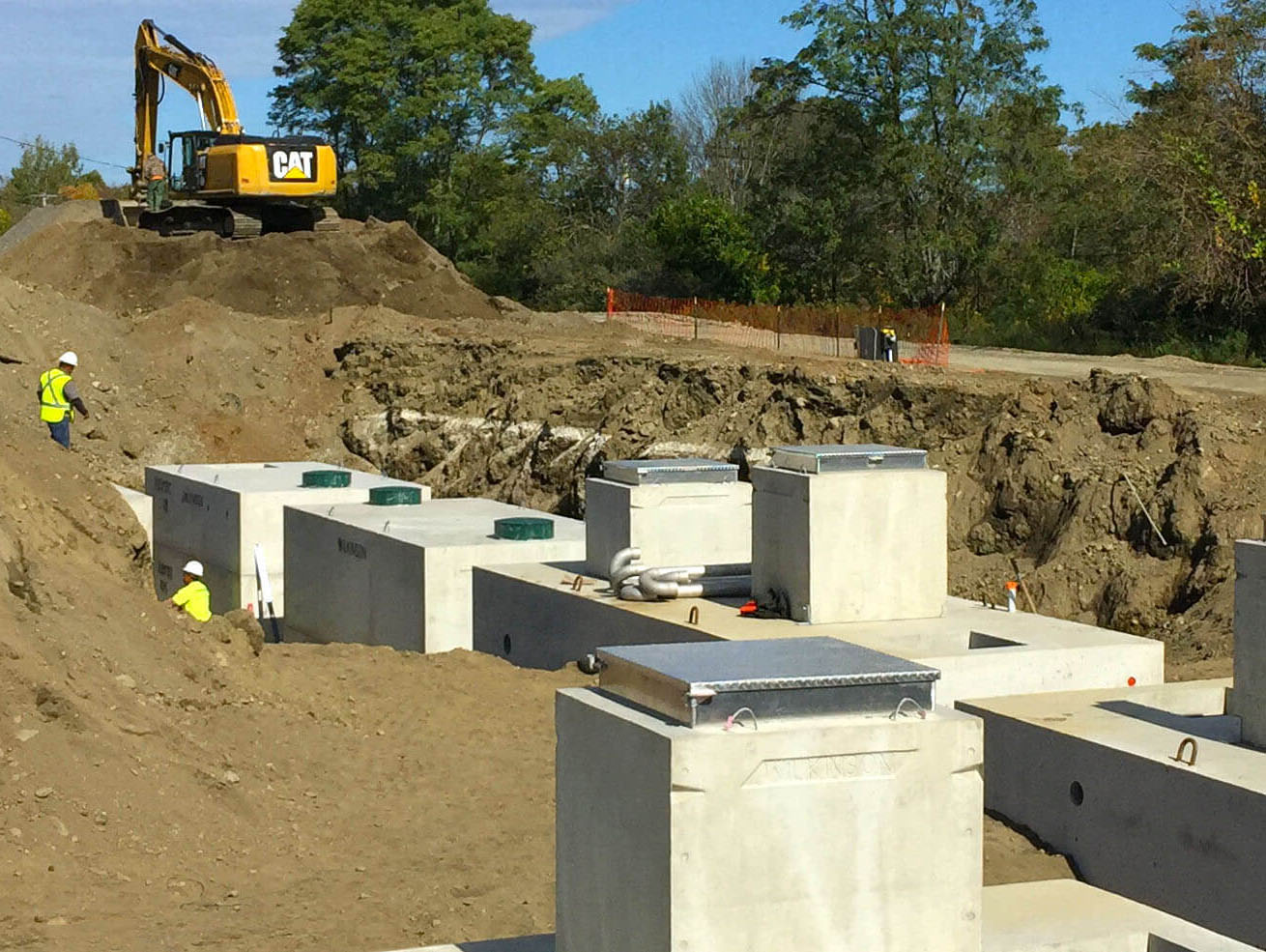
The installation site must be accessible to large heavy crane
equipment. A firm, flat and level area of sufficient size to allow
manoeuvring room for this type of equipment must be provided. This area
must be free of overhead wires, tree limbs, or other above-grade
obstructions which could affect normal crane operation.
EXCAVATION
Excavation length and width should allow for a minimum of 300 mm
clearance on all sides of the precast. More space must be allowed if
any work is to be done on the outsides of the unit after installation.
To minimize stress on a tank or chamber, it should be placed on a base
of gravel or crushed stone, minimum 150 mm thick. Soil conditions must
be firm and stable.
SOIL CONDITIONS
Most of our precast tanks, manholes and chambers are designed for
installation in firm stable soil. Unless designed for such use our
product warranty is void where an installation involves
saturated/unstable soils. Regardless of any design enhancements the
precast structure must always be placed on a flat, firm supporting
surface.
Please consult the factory before specifying precast elements for use in unfavourable
soil conditions.
JOINT SEAL
The mating surfaces of the joint must be clean and dry. The
lower precast section should be placed in its final position in the
excavation. The joint of this section should be made clean and dry,
then mastic strips of sealant applied. Ensure that the ends of each strip overlap by a minimum of 25mm as the sealant
is laid around the joint.
-
The mating surfaces of the joint must be clean and
dry. The lower precast section should be placed in its final position
in the excavation. The joint of this section should be made clean and
dry, then mastic strips of sealant applied.
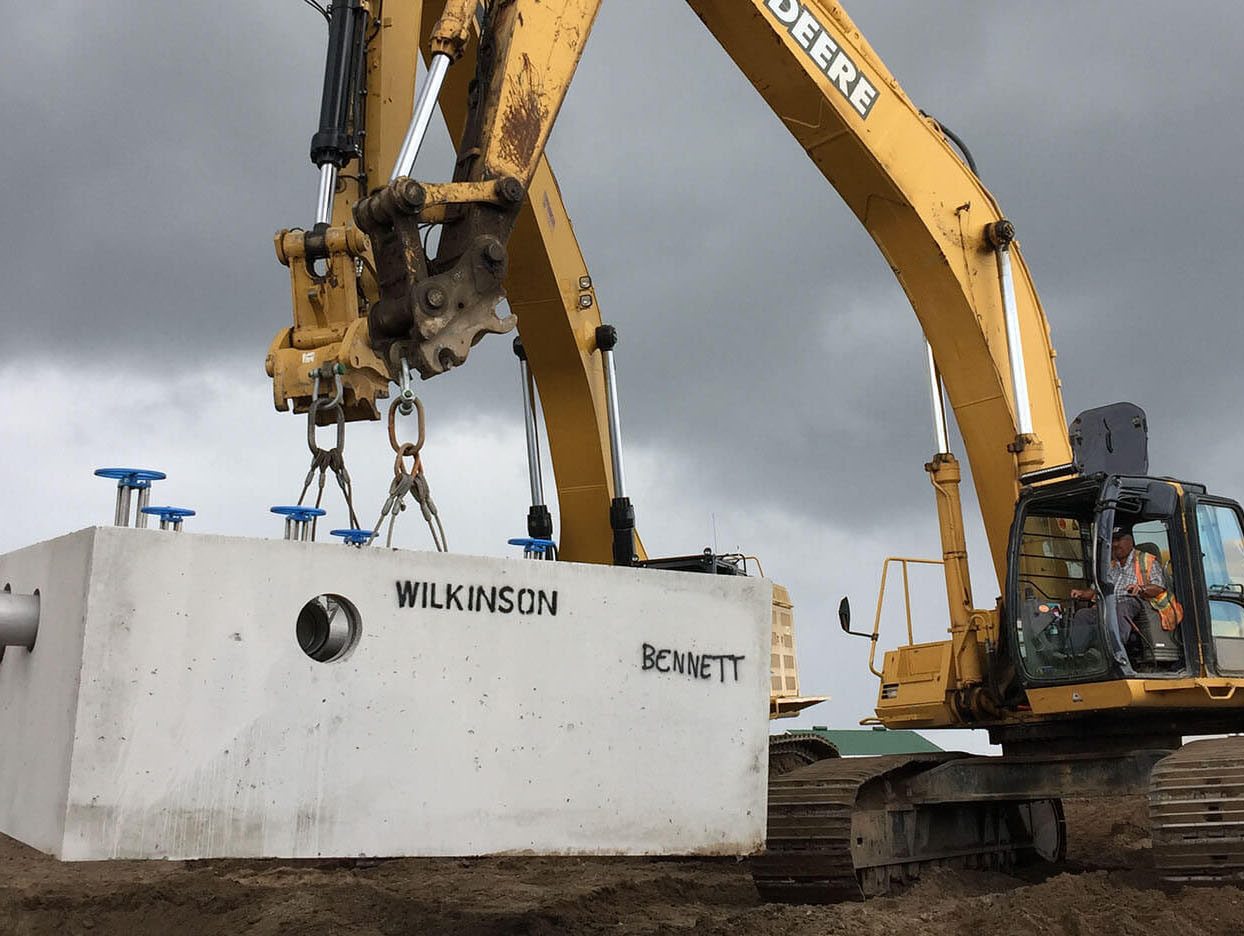
- Using lifting equipment that is safely adequate for
the job, hoist each subsequent precast section a few feet above the
ground in an open area away from the excavation. The joint surface of
this section must now be inspected. A broom should be used to sweep
away adherent debris. Care must be taken that the people preforming
this task have ample room to manoeuvre and do not at any time work
directly under the hanging load.
Should it prove impossible to clean the joint properly in this way, the
section must be safely blocked up in position allowing access from
underneath.
- Once the joint surfaces are clean, dry and free of
debris and extra mastic has been applied in areas where the male or
female joint might have been chipped or broken in handling, the upper
section can be carefully set directly onto the lower section.
- Allow the structure to stand until the mastic is
completely crushed into all parts of the joint and it stops extruding
from the sides. Remove the excess mastic and ensure the outer wall is
clean and dry in the area 8'' above and below the joint. Apply TWO
COATS of mastic primer using a paint brush or roller to the outer wall
surface (8'' above and below the joint). (See Fig.1)
- Apply the mastic membrane to the primed area making
sure it is centred over the joint. The protective paper backing should
be removed progressively as the mastic band is applied. Using a roller
or other blunt shape, push the mastic firmly onto the primed surface
rolling out any ripples or folds.(See Fig.2)
- An overlap is necessary when joints occur in the
mastic band. Apply primer to back of the section that will be
overlapped approximately 12''. Place the overlapping end onto the
primed section and roll into place.
TESTING
Fill the precast tank or chamber with water to 18 inches (460
mm) above the connection. Observe the connection at the outside of the
tank for a suitable period of time; usually between 2 - 24 hours.
Fill the tank or chamber with water to 18 inches (460 mm) above the
joint. Observe the outside wall at the joint for a suitable period of
time; usually 2 - 24 hours.
Fill the tank or chamber to the underside of the roof slab or to a
point up inside the access riser. The access riser should be a one
piece casting integral with or mechanically connected and sealed to the
top of the structure. Note the liquid level, let stand for a suitable
period of time and check the level.
CAUTION
A precast vessel is subjected to internal pressure
when it is filled with water. Some tall flat sided tanks or chambers
rely on support from the surrounding earth to resist stress imposed by
the contained liquid. It is recommended that the tank or chamber at no
time be filled higher than 24 inches (600 mm) above the lowest outside
level of back fill.
BACK FILLING
Back fill material must be free of boulders and large stones. Back
fill must be placed in layers progressively against the four sides of
the precast structure. When back filling with an excavator do not drop
back fill onto the precast or into the excavation from a height greater
than one metre. The wheels or tracks of back filling equipment must be
kept at least one metre away from the tank or chamber. At no time
should heavy equip- ment come in contact with any part of the precast.
COMPACTION OF BACK FILL
Compaction of fill around a precast tank can impose stresses
sufficient to cause failure of the walls. Discretion must be used in
this operation. Naturally tanks with comparatively thin walls are more
susceptible to damage than some of the heavier designs.
BOUYANCY
Although concrete tanks are very heavy, they will float in a fairly
shallow depth of water. If the tank or chamber must remain free of back
fill for testing purposes etc., for any appreciable length of time,
measures must be taken to ensure that water does not accumulate in the
excavation.
Download printer-friendly PDF version [133k]
|